Article: What Sea Glass Actually Is, and Why Bali's Is Different
What Sea Glass Actually Is, and Why Bali's Is Different
Most sea glass on the market isn't really sea glass. It's glass that's been tumbled in a machine to fake the weathered look, which defeats the entire point. Real sea glass takes decades to make. Here's how that actually happens, and why Bali produces some of the best of it.
How Sea Glass Actually Forms
Sea glass starts out as nothing special: a bottle, a jar, a broken windowpane. Once it ends up in the ocean, thrown in, washed off a beach, lost from a boat, the water takes over.
Waves drag it across rock and sand for years, sometimes decades. The sharp edges round off first. Then the surface changes. Saltwater slowly eats into the glass at a microscopic level, leaving it frosted instead of glossy. Twenty to a hundred years later, what started as trash comes out looking like a gemstone.
There's no shortcut for this. Tumblers can fake the frosted look in a few hours, but anyone who's handled real sea glass can tell the difference immediately. Machine-tumbled glass is uniform. Real sea glass has a depth you can actually feel.
Why Bali Produces So Much of It
Sea glass tends to collect near old ports and coastal towns, places where glass has been entering the water for generations. Bali qualifies on both counts. Centuries of fishing villages, trade routes, and ocean currents moving debris across the Indonesian archipelago have left its coastline with a steady supply, in a wide range of colors and ages.
The rarest pieces, deep blue, orange, red, turquoise, usually come from old medicine bottles, early 1900s glassware, or ship signal lights. The common ones are clear, brown, and green, the leftovers of beer bottles, wine bottles, and soda bottles. Every piece carries a small history nobody wrote down.
Why No Two Pieces Match
Sea glass is shaped by forces nobody controls: which current it drifted in, which rocks it hit, how many years it spent underwater. That means even two pieces of the same color can differ completely in shape, thickness, and clarity.
You can't manufacture that. You can't order a kilo of identical pieces. You find them one at a time, on the beach, and that's it.
How We Source and Set It
We hand-pick every piece from Bali's coastline ourselves. Each one gets cleaned and sorted by color, shape, and quality, and only the pieces with the right clarity and form make it into the collection. Most don't.
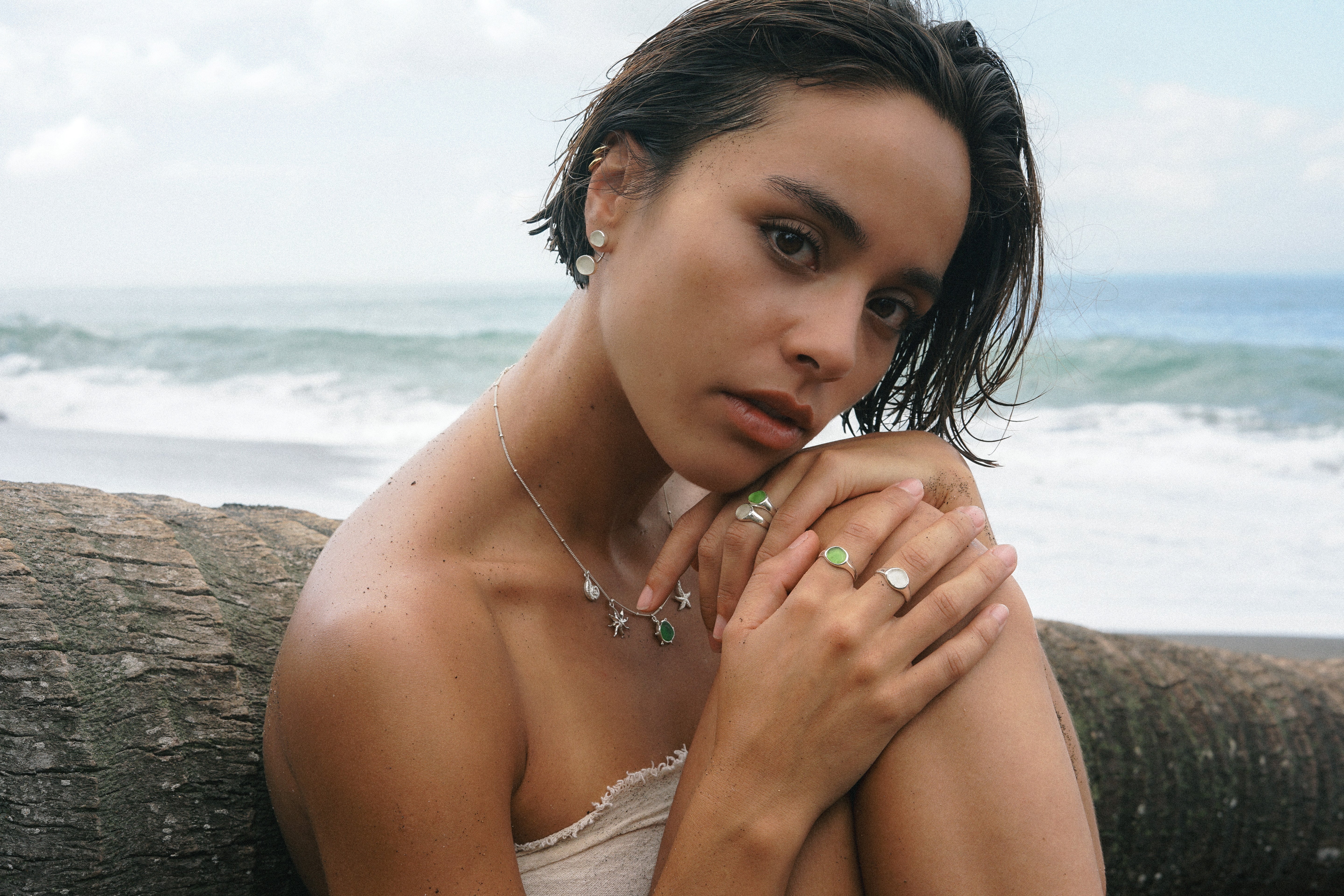
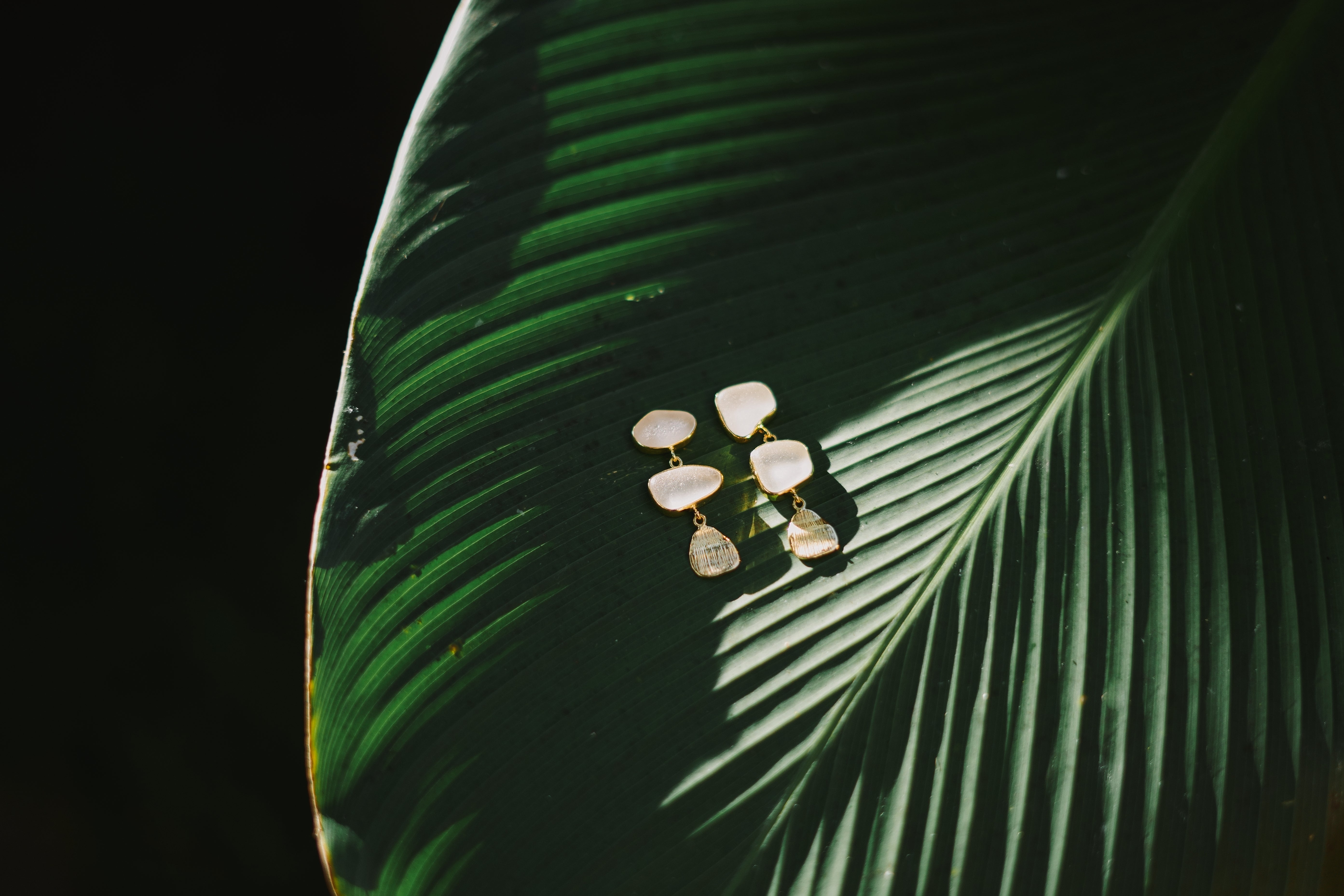
From there, our Balinese artisans set each piece by hand into sterling silver 925 or 18k gold-plated silver. Because no two pieces of glass are the same shape, no two settings are either. Each one is built around the specific piece it holds.
Once a piece sells, it's gone. We don't restock the same shape twice, because we can't.
A Quick Guide to Sea Glass Colors
| Color | Rarity | Usually came from |
|---|---|---|
| White / clear | Most common | Clear bottles and jars |
| Green | Common | Wine and soda bottles |
| Brown / amber | Common | Beer and spirits bottles |
| Sage / soft green | Less common | Older glassware |
| Seafoam / pale aqua | Uncommon | Early 1900s glass |
| Cobalt blue | Rare | Old medicine and poison bottles |
| Cornflower blue | Rare | Vintage ink bottles |
| Teal / deep green | Rare | Specialty bottles |
| Orange / red | Very rare | Old tail lights, decorative glass |
Most of what you'll find in our collection is white, green, and brown, since that's what Bali's coastline gives up most consistently. The rare colors show up when the ocean decides to hand one over.
Is It Actually Sustainable
Yes, and not in the way that word usually gets used in marketing. Sea glass is material that would otherwise sit on the ocean floor or wash around the shoreline indefinitely. Turning it into jewelry is reclamation, plain and simple: something thrown away, made precious again.
Every artisan involved in making it is paid fairly, and the entire process, from beachcombing to setting, stays local to Bali.
Find It In Person
Kamaya has two stores in Bali:
Kamaya Jewelry
Jl. Hanoman No. 4, Ubud
Kamaya Island
Jl. Banjar Kaja I, Pantai Jungut Batu, Nusa Lembongan
Or shop the full collection at shopkamaya.com, with worldwide shipping.